
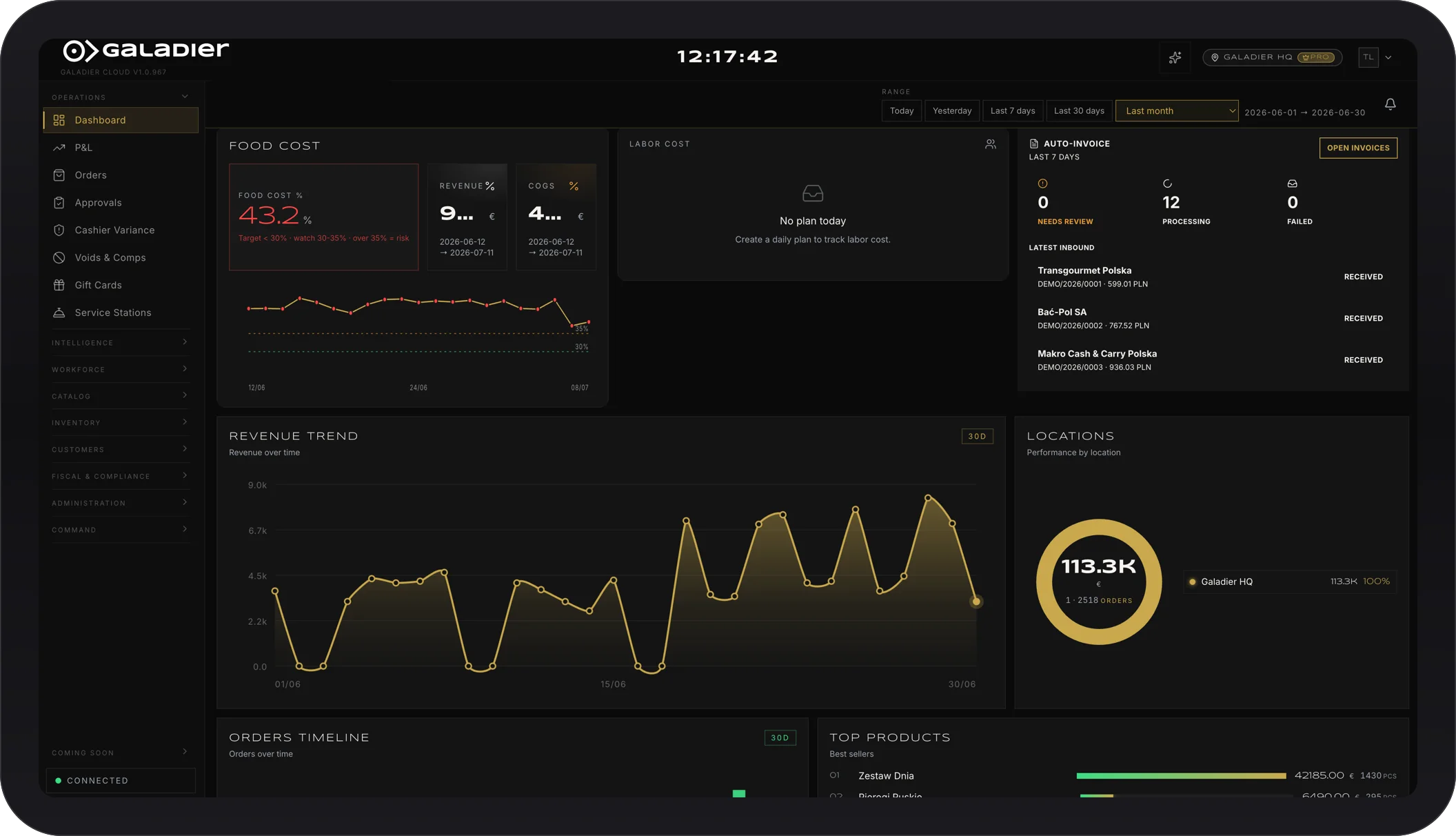
Ask any restaurant owner what the most annoying part of the month is and, if they’re honest, it isn’t the packed Saturday or the broken walk-in. It’s the first few days of the following month, when the numbers have to be gathered, cross-checked, sent to the accountant, and the answer to “did we make money or not” finally comes out. At most venues, that month-end close is a manual chase through paperwork and files. This article covers what actually runs manually today, what it costs, and what it means in practice to get all of it down to one export.
Before we start: month-end close has legal and tax parameters that vary by jurisdiction and change over time, and every venue has a different structure. What follows is the general shape; your accountant has the last word on the specifics of your case.
What runs manually today
At a typical venue, month-end close is assembling information that lives in four or five different places, none of which talk to each other:
1. Z reports and sales. You gather daily reports from the till, add them up, split them by payment method (cash, card, delivery platforms). If you have more than one register or location, you consolidate by hand.
2. Tax filing reconciliation. You check that what was issued matches what was filed with the tax authority. When something doesn’t line up, a receipt that didn’t upload, a cancellation that didn’t go through, the hunt starts, day by day, to find where it broke.
3. Purchases and supplier invoices. You gather the month’s invoices, enter them, cross-check against deliveries. This is also where your food cost numbers hide, if you have them.
4. Payroll. Staff hours, shifts, overtime, often living in a separate system (or a separate spreadsheet), that need to come out so you know the month’s real labor cost.
5. Sending it to the accountant. All of the above, in whatever shape you have it, by email or in a folder. Then the questions: “what’s this card discrepancy?”, “a Z report is missing on the 14th,” “why don’t the delivery platforms reconcile?”
The work isn’t just gathering. It’s that each of these pieces has its own format, its own logic, and its own errors, and you’re the glue holding them together, every month, by hand.
What this actually costs
In time, for a mid-sized venue, you’re easily looking at half a day to a full working day a month, combined, yours or your accountant’s, which means billable hours. Twelve times a year.
But the worse cost isn’t the time, it’s the errors and the delay. When numbers are manually assembled from five sources, every manual transfer is a chance for a mistake. A missed Z report, a payment method entered in the wrong column, a cancellation that didn’t get subtracted. Either the accountant catches these (and you both lose time), or nobody catches them (and you’re carrying a wrong picture of how the business is doing).
Then there’s the hidden cost of a delayed picture. When close takes days, you find out how last month went in the middle of this one. By the time you see margin slipped, half the current month has already gone by with the same problems.
Where the time actually goes
It’s worth breaking the “half a day” into pieces, because the problem isn’t one big job, it’s ten small ones, none of which feels worth automating on its own:
- Reconciling payment methods. Till cash against counted cash, card sales against processor settlements, delivery platforms against their own reports. Each channel closes on a different day with different logic.
- “Missing” documents. A receipt that was voided but not processed correctly, a missing Z report, a refund entered as a sale. Hunting these down is the most frustrating part, because you don’t know something’s missing until the total won’t reconcile.
- Translating between systems. The till calls the dish “Carbonara,” the accounting system wants a revenue code, payroll lives in a third program. Someone builds the bridge every month, by hand.
None of these tasks is individually “hard.” All of them together, twelve times a year, are a steady tax on the time that actually matters: running the restaurant.
What “one export” means
The alternative isn’t “a better spreadsheet.” It’s having all these pieces live inside the same system from the start, so at month end you’re not assembling them, you’re just exporting them.
Think about what that means in practice. When the system that rings up orders is the same one that:
- keeps the Z reports and sales, already split by payment method and location,
- files and reconciles with the tax authority, so you know mid-month what doesn’t line up instead of finding out at the end,
- has purchase invoices and food cost tied to stock,
- and tracks staff hours and shifts for labor cost,
then “month-end close” stops being an assembly job. It becomes one export: a file that already contains filing reconciliation, sales breakdown, payroll and labor cost, and Z reports, all cross-checked against each other, in the format your accountant wants.
The accountant doesn’t disappear, and shouldn’t. What changes is what they do: instead of gathering and cross-checking numbers (low-value work you’re paying premium hourly rates for), they spend their time on what you actually need a professional for, tax strategy, planning, advice. That’s why they’ll thank you: you’re sending them something clean and complete, not a folder of mismatches to untangle.
The benefit that isn’t visible on day one
Beyond the hours, one export changes the speed at which you learn how the business is doing. When close is a button, you can run it whenever you want, not just at month end. You see last week the moment it ends, not 20 days later. And because the numbers all come from the same source, they don’t disagree with each other: the same sales total shows up in the tax reconciliation, the revenue breakdown, and the food cost. The source mismatch that eats most of the hours in a manual close simply doesn’t exist.
There’s a calm to it too. The “something doesn’t reconcile” feeling hanging over every month end is, fundamentally, the uncertainty that somewhere in those five files is a mistake you haven’t spotted. When the numbers come from a system that kept them right from the start, that uncertainty goes away.
What it means for your accountant relationship
Worth a word on why the title says your accountant will thank you, and it isn’t a figure of speech. Accountants bill time. When you send five files with mismatches, their first pass is reconciling them and sending you questions back. That pass is pure billable time you’re paying to fix something that shouldn’t have broken.
When they receive one export where the numbers already agree, their work changes nature. They’re not spending hours on “why don’t the cards reconcile,” they’re working on tax strategy, planning, the decisions where a professional’s judgment is actually worth something. You get more value for the same money, instead of paying premium hourly rates for assembly work a system could have done.
And there’s reciprocity: an accountant who gets clean data every month is an accountant who answers faster and flags problems earlier. The quality of what you send shapes the quality of what you get back.
How Galadier does it
In Galadier, orders, payments, tax filing and reconciliation, purchases and food cost, and staff hours all live in the same system from day one. At month end you’re not assembling anything: you run one export that ties tax reconciliation, payroll, and Z reports into one file, ready for your accountant. Mid-month, if something doesn’t reconcile on the filing side, you see it then, not on the 10th of the next month.
See how it all connects on the features page, and if you want to see it with your own numbers, and have your accountant understand what they’ll be receiving every month, book a demo. Bring an old close and we’ll show you how much shorter it gets.