
Food cost is the most important number most restaurants don’t actually look at. Not because they don’t know it in theory, everyone has heard “stay under 30%”, but because it gets calculated once, in a spreadsheet, and then sits there while supplier prices climb every quarter. This article walks through the formula, a full worked example on a real dish, the mistakes we see most often, and, the most useful part, how to read the number to decide whether to change a price or a portion.
The formula
A dish’s food cost is a percentage:
Food cost % = (cost of the dish’s ingredients ÷ net selling price) × 100
Two clarifications that account for half of all mistakes:
- Ingredient cost means everything that goes on the plate: the main item, the garnish, the sauce, the oil, the seasoning, the bread that comes “free” on the side. Not wages, not rent, not electricity, those are a separate chapter.
- Net selling price means without tax. The sales tax you collect isn’t yours, you remit it. If you cost against the menu price, your food cost looks better than it really is.
There’s also the actual food cost at the venue level, calculated from inventory:
Actual food cost % = (opening stock + purchases − closing stock) ÷ net sales × 100
The first formula tells you what your food should cost. The second tells you what it actually cost. The gap between them is waste, errors, eyeballed portions, comps that never hit the register, and that’s usually where the lost margin hides.
A worked example
Let’s cost a classic carbonara. Purchase prices below are illustrative, plug in your own, that’s the whole point.
| Ingredient | Quantity | Purchase price | Portion cost |
|---|---|---|---|
| Spaghetti | 125 g | $2.00/kg | $0.25 |
| Pancetta | 70 g | $11.00/kg | $0.77 |
| Cream | 80 ml | $4.50/L | $0.36 |
| Egg yolk | 1 | $0.35/egg | $0.35 |
| Parmesan | 25 g | $18.00/kg | $0.45 |
| Oil, pepper, salt | · | · | $0.13 |
| Bread on the side | 1 | · | $0.20 |
| Total | $2.51 |
Menu price: $14.00. To get the net price, strip out tax, here we’ll use a hospitality rate of 10% (confirm the applicable rate for the item with your accountant):
- Net price: 14.00 ÷ 1.10 = $12.73
- Food cost: 2.51 ÷ 12.73 = 19.7%
19.7% for a pasta is healthy. Pasta and salads usually “subsidize” the menu; meat and seafood run higher, a beef fillet can come out at 38-42% and still be fine, as long as you know it and the rest of the menu balances it. What matters is the venue average, and for most full-service restaurants it lands reasonably in the 25-35% band.
The mistakes we see most often
1. Costing without yield loss. Pancetta bought at $11.00/kg doesn’t all reach the plate. If you lose 10% per kilo in trimming and cooking, the real cost of a served gram is 11.00 ÷ 0.90 = $12.22/kg. In our example the pancetta portion then costs $0.85 instead of $0.77, small per dish, thousands a year across the whole menu.
2. The “invisible” ingredients. Oil, butter, salt, bread, the delivery packaging. A takeout box with napkins and cutlery can cost $0.40-0.70, on a $12 dish that’s several food-cost points you charged for nowhere.
3. Costing against the tax-inclusive price. We saw it above: 2.51 ÷ 14.00 = 17.9% instead of the correct 19.7%. A couple of “free” points on paper that don’t exist at the till.
4. Costing once a year. Wholesale prices for cheese, oil and meat move. If parmesan goes from $18 to $22/kg, the carbonara got more expensive without anything changing in the kitchen. When that happens to 5-6 staple ingredients at once, the venue average shifts 2-3 points in a single quarter, and you find out at year-end.
5. Comps and staff meals that aren’t recorded. The coffee for the regular, the salad that “went out wrong,” the shift dinner. All of it consumes stock without producing a sale. You don’t need to cut it, you need to ring it as a zero sale or internal consumption, so the real number comes out clean and you’re not hunting for “theft” where there’s hospitality.
6. No comparison of theoretical to actual. If the recipe says 70 g of pancetta and the cook eyeballs 90 g, your theoretical food cost is fiction. A theoretical-vs-actual gap above 2-3 points almost always means one of three things: eyeballed portions, unrecorded waste, or sales that never hit the register. Without regular inventory you’ll never see it.
When to change a price, and when a portion
The number alone doesn’t say “raise the price.” Pair it with how well the dish sells:
- High food cost + low sales: the easy candidate. Change the recipe, shrink the portion, or drop the dish. No one will mourn it.
- High food cost + high sales: handle with care. The dish brings people in. Before you raise the price, try to cut the cost: a different supplier, a smaller garnish, 10 g less cheese no one will notice. A $0.50 increase on a popular dish almost always lands more easily than a $1.50 one.
- Low food cost + high sales: the menu’s workhorses. Don’t touch them, protect them and give them a better spot on the menu.
- Low food cost + low sales: a presentation or menu-placement problem, not a price one.
A practical rule for re-pricing: don’t wait for the once-a-year “big menu change.” When a staple ingredient climbs more than 10-15% and looks like it’s staying there, re-cost the dishes that use it then, not eventually. And when you change a portion instead of a price, change it in the recipe and weigh it, “a little less” without a scale becomes “a little more” within two weeks.
The problem isn’t the formula, it’s the upkeep
Everything above takes one afternoon in a spreadsheet. The hard part is what comes after: updating purchase prices every time an invoice arrives, re-running the math for every affected dish, doing inventory to see the actual number, and comparing the two. In practice this stops happening by month two, not from laziness, but because at 11:30 p.m. after close, no one opens a spreadsheet.
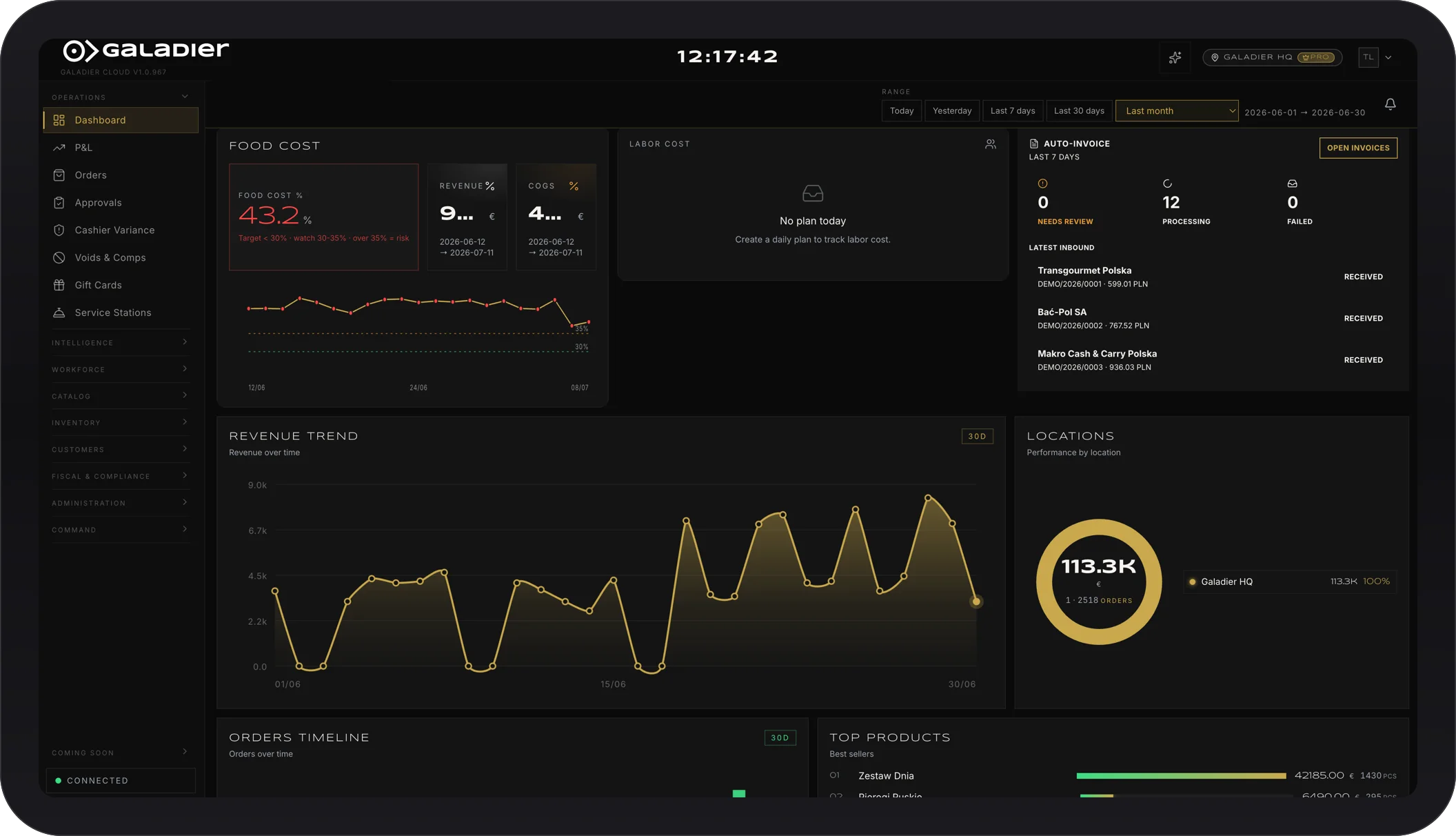
This is where having the system do it for you helps. In Galadier each dish has its recipe, each sale subtracts its ingredients from stock, and each new purchase invoice updates the cost. So you see live food cost per dish, not what you calculated in January, but what holds today, at today’s supplier prices. When parmesan gets pricier, you see it in the carbonara that same week, not in next year’s accounts.
If you want to see what this looks like with your own menu and your own suppliers, book a demo, bring two or three dishes and their purchase prices, and we’ll cost them live.