
Inventory is the job everyone knows they should do and almost nobody does properly. It starts with good intentions, “we’ll count every Sunday night”, and ends up as a spreadsheet last updated three months ago. Not from laziness: manual stock counting is one of the most time-consuming, tedious, error-prone jobs in the building. This article covers what manual counting actually costs, what changes when stock stays current on its own, why a handful of targeted spot audits is enough to keep the number honest, and what all of this means for the most important figure it feeds: food cost.
What manual counting actually costs
Let’s put numbers on it, illustrative ones, plug in your own. A mid-sized restaurant with a decent stockroom and walk-ins easily carries 150 to 300 ingredient codes. A proper count, weighing part-used items, logging, entering into a spreadsheet, takes 3 to 5 hours, often for two people.
Do it properly every week and you’re looking at 15 to 20 hours a month spent counting. Annualized, that’s a full work-week every two months, paid out of the most valuable hours you have: the ones right after close, with a tired staff.
And here’s the trap: because it costs so much, it doesn’t happen often. And when it doesn’t happen often, it loses its value, because a three-month-old stock number doesn’t tell you what’s happening now. You pay for expensive work and get stale information back.
There’s a hidden cost to the errors too. At 11:30pm, the person counting mixes up 4kg with 2.5kg, misreads the scale, forgets the second walk-in. Every one of those errors poisons the food cost calculation downstream, and sends you hunting for “theft” or “waste” where the real problem was a miscount.
The alternative: stock that stays current on its own
The idea is simple and it changes everything. Instead of finding out what’s left on the shelf once a month, you always know it, every day, without anyone picking up a clipboard.
Everything that moves your stock already happens in the restaurant: deliveries arrive, dishes go out. When the system you run on already knows both, the stock number simply stays up to date. Sell 40 carbonaras tonight and tomorrow morning you already see how much spaghetti and pancetta is left, without weighing anything.
That’s inventory without counting: you know at any moment what you should have of each code. Inventory stops being a counting night and becomes a number that just exists, always current.
The benefit isn’t only the hours saved. For the first time you have a stock number that’s current, not quarterly. You see the pancetta running out on Thursday before the weekend, not when the kitchen asks for it and it isn’t there.
Why you still need spot audits (just a few)
A stock number that keeps itself current tells you the expected stock: what you’d have if every dish was made exactly to spec and every sale got rung up. Reality has leaks the recipe doesn’t know about: trim waste, a cook eyeballing a portion, a broken glass, a returned plate, staff meals.
That’s why you keep a small slice of manual checking, but a completely different kind from a full count. Instead of counting all 250 codes weekly, you run a spot audit: count a few targeted codes and compare them to the expected number.
Which ones? The expensive and sensitive ones: meats, fish, premium cheese, the bottles behind the bar. A handful of codes that make up most of your stock’s value. Ten minutes, not five hours.
The expected-versus-actual comparison is the payoff:
- They match? Great, your recipes are accurate and staff follow them.
- Actual stock is short against expected? There’s a leak somewhere: eyeballed portions, unlogged waste, or sales that never got rung up. Now you know where to look, and which code.
With spot audits on the right handful of codes you catch 80% of the problem for 10% of the effort. That’s inventory without counting: the heavy lifting is done for you, and you keep only the accuracy check where it matters.
How often, and which codes
A practical schedule that doesn’t eat your week: check the small set of high-value codes, meats, fish, expensive cheese, premium spirits, weekly, because that’s where most of the value and risk sits. Usually 15 to 25 codes, not 250, ten minutes of work.
Mid-value codes, vegetables, pasta, basic cheeses, get a more thorough spot audit monthly. Low-value, high-volume codes, flour, sugar, napkins, rarely need frequent counting at all; the always-current number covers them almost perfectly since portions are stable and waste is minimal.
The logic is the familiar 80/20: a small share of your codes holds most of the inventory value. There’s no reason to spend the same time on salt as on beef fillet. Put the checking where the money is and the time you need collapses while the accuracy that matters goes up.
One more benefit: when a specific code shows a consistent variance, you know exactly where to focus. You’re not searching “somewhere in the restaurant, stock is disappearing”, you’re seeing that pancetta is running 8% over expected every week, and the conversation with the kitchen gets specific: portioning, waste, or unrung sales.
What it means for your food cost
All of this feeds one number. Actual food cost is calculated as:
(opening stock + purchases − closing stock) ÷ net sales × 100
Two of those terms are stock numbers. If “opening” and “closing stock” are manual 11:30pm estimates, your food cost carries every counting error with it. A 2% miscount on closing stock can shift your food cost by a full point, and you won’t know if the lost margin is a real problem or a scale error.
When stock stays current on its own, closing stock isn’t a late night estimate any more, it’s a number you already have, confirmed by spot audits. Food cost becomes reliable enough to act on: change a supplier, re-cost a dish, talk to the kitchen about portions. Without reliable stock, food cost is a number you look at but don’t trust, and a number you don’t trust doesn’t change anything.
There’s a waste angle too. When you know in real time what you have and how fast it’s moving, you order correctly: less spoilage from over-ordering, fewer “we ran out” moments mid-shift. Stock that tracks itself doesn’t just save you the counting, it saves you from both ends of bad ordering.
”This won’t work in my kitchen”
The most common objection is that cooks don’t follow recipes precisely, so the stock number will be wrong. It’s exactly backwards. If portions are loose, you need this more, not less, because the expected-versus-actual gap is the only tool that shows you, with a number, how loose. Without it, “they don’t follow the recipe” is an impression. With it, it’s “pancetta is running 20% over” and you know what to fix.
The second objection is “I run specials and change the menu constantly.” No problem: it works for every dish on your menu. Cost the specials quickly when you add them, or leave them to spot audits. You don’t need perfection across the whole menu, just coverage on the 20 to 30 dishes that make 80% of your sales.
The goal isn’t a system that knows every gram perfectly. It’s a system that saves you five hours of counting and tells you, accurately enough to act on, where your stock is going. Perfection is the enemy of getting this done at all.
How Galadier does it
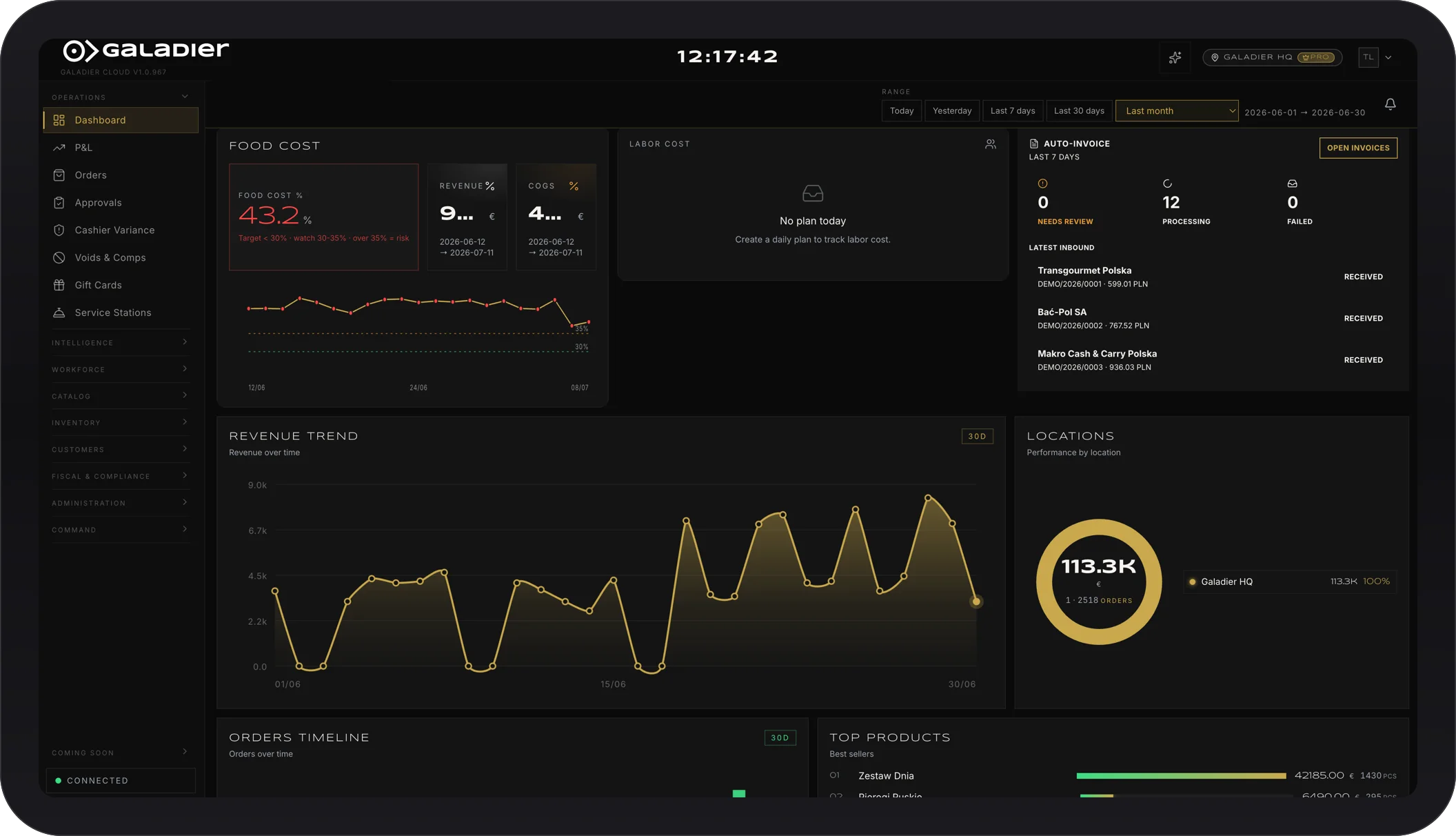
With Galadier you always know what is in stock in every store, without post-shift counts, and you see live food cost per dish without opening a spreadsheet. Spot audits take a few taps, and the gap between expected and actual stock shows you exactly which code is running hot.
If you want to see what your stock looks like when it tracks itself, and how many counting hours you get back, see more on the features page or book a demo with two or three of your most painful codes, and we’ll show you the expected-versus-actual gap live.